


Personal branding is the deliberate practice of shaping what people understand, feel and expect when they encounter your name. It is not a logo, a color palette or a steady stream of self-promotional posts. It is the accumulated meaning attached to you—your reputation made visible, memorable and repeatable.
The real personal-branding problem is not visibility. It is reputation without intention.
If you are unsure what your reputation currently communicates—or where it may be costing you opportunities—a personal brand audit immediately reveals what people and AI systems discover, believe and remember about you.
Long before a prospective client calls, hires, refers, invites or recommends you, that person is assembling a picture. They may hear your name from a trusted friend, search it on Google, skim your LinkedIn profile, read reviews, watch a short video, visit your website or ask an AI assistant who is credible in your field. Every result becomes a piece of evidence. Together, those pieces either reinforce one confident conclusion—or create friction and doubt.
That is why personal branding matters most in businesses where trust precedes a transaction. A physician may be exceptionally capable, an attorney deeply experienced, a travel advisor unusually resourceful, an author full of original insight, and a real-estate professional brilliant at negotiation. Yet expertise that is difficult to discover, understand or verify is commercially weaker than expertise that is clearly expressed and consistently experienced.
This guide explains what personal branding really means, why reputation must come first, which professionals benefit most, and how my XMarketing Framework—Clarity, Connection and Community—can turn scattered impressions into a growth asset.
What Is Personal Branding?

Personal branding is the process of clarifying and communicating the distinctive value, expertise, character and experience associated with a person’s name. A strong personal brand helps the right people answer four questions quickly: Who are you? What do you stand for? Why should I trust you? Why are you relevant to me?
The word “brand” sometimes makes accomplished professionals uncomfortable because it can sound artificial. But a brand is not a costume. At its best, it is an accurate shortcut. It helps the market recognize a real pattern: the problems you solve, the perspective you bring, the way you make people feel and the standards they can expect from you.
Personal brand vs. reputation
Reputation is what people collectively believe about you. Personal branding is the intentional work that helps those beliefs become accurate, coherent and useful. Reputation is the outcome; branding is part of the system that influences the outcome.
Personal brand vs. marketing
Marketing creates attention and movement. A personal brand gives that attention meaning. Advertising may put your name in front of someone, but your brand determines whether the person leans closer, remembers you and feels safe taking the next step.
Personal brand vs. popularity
Popularity measures attention. Authority measures earned confidence. A large audience can be helpful, but it is not required. Many of the strongest personal brands are narrow, respected and highly valuable because the right community knows exactly why that person matters.
Your Reputation Is the Front Door
A referral no longer ends with “Call David.” It usually continues with “Let me look him up.” The digital check may take less than a minute, but it can confirm trust or quietly dissolve it. In professional services, this second impression often determines whether the first impression survives.
Reputation is built from signals: search results, reviews, credentials, media appearances, testimonials, content, responsiveness, visual professionalism, community associations and the lived experience people have with you. One signal rarely defines the whole brand. The pattern does.
This is especially important in an AI-mediated marketplace. AI systems synthesize information from public sources; they do not experience your intentions. If your expertise is inconsistently described, poorly documented or disconnected across the web, an answer engine may misunderstand you, omit you or repeat an outdated version of you. The solution is not to write for robots. It is to make your expertise unmistakably useful, well-evidenced and consistent for people—then structure it so machines can understand it too.
Your digital footprint is no longer only something people read. It is source material that search engines and AI systems interpret.
The five most common reputation gaps
- The search gap: The first page of results does not reflect the work you do today.
- The clarity gap: People see many activities but cannot explain your central value in one sentence.
- The proof gap: Claims are abundant, but specific outcomes, credentials, reviews or examples are thin.
- The experience gap: Your message promises care, authority or responsiveness, but the real interaction feels generic or difficult.
- The consistency gap: Your website, profiles, content, biography and introductions describe different versions of you.
These gaps are expensive because they create cognitive work for the buyer. When people must reconcile contradictions or hunt for proof, uncertainty rises. Strong personal branding reduces that uncertainty without reducing the person to a slogan.
Why Personal Branding Matters More Now

Trust is scarce—and commercially decisive
People have more access to information and less patience for uncertainty. Edelman’s 2025 research reported that 80% of respondents trusted the brands they personally use—higher than their trust in major institutions. The lesson for a professional is not that every person must become a celebrity brand. It is that familiar, relevant and consistently positive experiences can earn a meaningful reservoir of trust.
Search has become an evaluation layer
A website is no longer the only destination. Your Google results, professional profiles, review platforms, social channels, interviews and videos form a distributed identity. The buyer moves among them, looking for confirmation. A strong brand creates continuity across that journey.
AI has become a recommendation layer
Google’s own guidance for appearing in generative search features emphasizes the same foundation as traditional search: useful, reliable, people-first content; accessible pages; accurate structured data; quality images and video; and clear evidence of who created the content. In other words, “AI optimization” is not a bag of tricks. It is disciplined communication, technical accessibility and credible proof.
Expertise is easier to publish—and harder to distinguish
AI can help almost anyone create polished content quickly. That increases volume, but it also raises the value of lived experience, specific opinions, recognizable stories and original frameworks. Generic fluency is plentiful. Earned perspective is not.
People buy the person behind the service
In high-trust services, buyers are evaluating more than competence. They are asking: Will this person understand me? Will they act in my interest? Will the experience match the promise? Personal branding makes those human dimensions legible before the first conversation.
Who Needs a Personal Brand Most?

Everyone has a reputation, but not everyone needs to invest equally in a public personal brand. The need rises when the individual’s expertise, judgment, relationships or presence materially influence the buying decision.
Business owners and professional-service leaders
For a founder, the personal and company brands often reinforce one another. The founder can humanize the business, explain its worldview and create confidence before the company has the scale or familiarity of a category leader. The risk is dependence: if the founder’s brand is the only source of trust, the company may struggle to scale beyond that person. The goal is an intentional bridge between founder authority and organizational credibility.
Real-estate professionals
Real estate is a trust-and-referral business built around consequential decisions. National Association of REALTORS® reporting shows that past clients and referrals remain major sources of business, and sellers consistently emphasize an agent’s reputation, honesty and trustworthiness. An effective real-estate brand therefore needs more than listing photos. It should communicate local knowledge, negotiation judgment, responsiveness, a repeatable client experience and proof from people already served.
Travel advisors and agents
Travel information is abundant; confident judgment is scarce. A travel advisor’s brand should show who they serve, which trips they understand deeply, how they prevent avoidable problems and what kind of support clients receive when plans change. Destination expertise attracts attention. Stories of care, access and problem-solving create trust.
Authors, speakers and thought leaders
An author’s book may introduce an idea, but the personal brand expands the idea into a body of work. A strong brand connects the thesis, voice, stories, media, speaking topics and audience transformation. It makes the person easier to understand, book, quote and recommend. The aim is not to talk about everything you know; it is to become meaningfully associated with the idea you most want to advance.
Doctors and healthcare professionals
Patients increasingly research physicians before scheduling. The American Medical Association has reported that online reviews, accurate profiles and a useful digital footprint play a major role in physician evaluation. For healthcare professionals, the personal brand must balance expertise with empathy, clarity and ethical restraint. Reputation management also requires privacy-aware responses: a physician cannot publicly “win” a disagreement by disclosing protected patient information.
Attorneys
Legal clients are often anxious, time-sensitive and unsure how to evaluate technical competence. An attorney’s brand should make the practice focus, process, experience and client philosophy clear—without guarantees, exaggeration or ethically problematic claims. The American Bar Association notes that prospects commonly search the lawyer’s name, review the website and read reviews after receiving a referral. Digital credibility can preserve a referral or squander it.
Executives, consultants and subject-matter experts
For leaders, personal branding can attract talent, partnerships, board opportunities, media, clients and internal influence. The strongest executive brands are not constant self-celebration. They are sustained records of useful thinking, principled decisions and credible participation in the conversations that matter to the business.
The Cost of Leaving Your Personal Brand to Chance

An unmanaged personal brand rarely stays neutral. It becomes incomplete. Old bios outrank current priorities. Review profiles go unanswered. Job titles describe responsibilities but not value. Content follows trends without building association. Competitors occupy the questions you should be answering. The market then fills the gaps with assumptions.
- You become difficult to refer because people do not have simple, accurate language to introduce you.
- You attract the wrong opportunities because your positioning is too broad or outdated.
- You compete on price because buyers cannot see a meaningful difference.
- You remain dependent on one platform, one employer or one source of leads.
- You are excluded from AI-generated shortlists because public evidence of your expertise is weak or ambiguous.
- You discover reputation problems only after they have affected a decision.
The inverse is powerful. When your reputation, message and experience align, every touchpoint compounds the others. A referral finds confirmation. A video makes the website feel human. A review proves the promise. A keynote strengthens search results. A useful article gives an AI system a clear source to cite. That is brand equity at the level of a person.
The XMarketing Framework: Share, Care and Lead
I developed XMarketing around a simple belief: marketing should create experiences that move people, not merely messages that interrupt them. Applied to personal branding, XMarketing provides a practical operating system for reputation. At its center is the personal brand. Around it are three continuous responsibilities—Share, Care and Lead—each expressed through three observable behaviors and one strategic outcome.
Share to own the narrative. Care to increase engagement. Lead to build community.
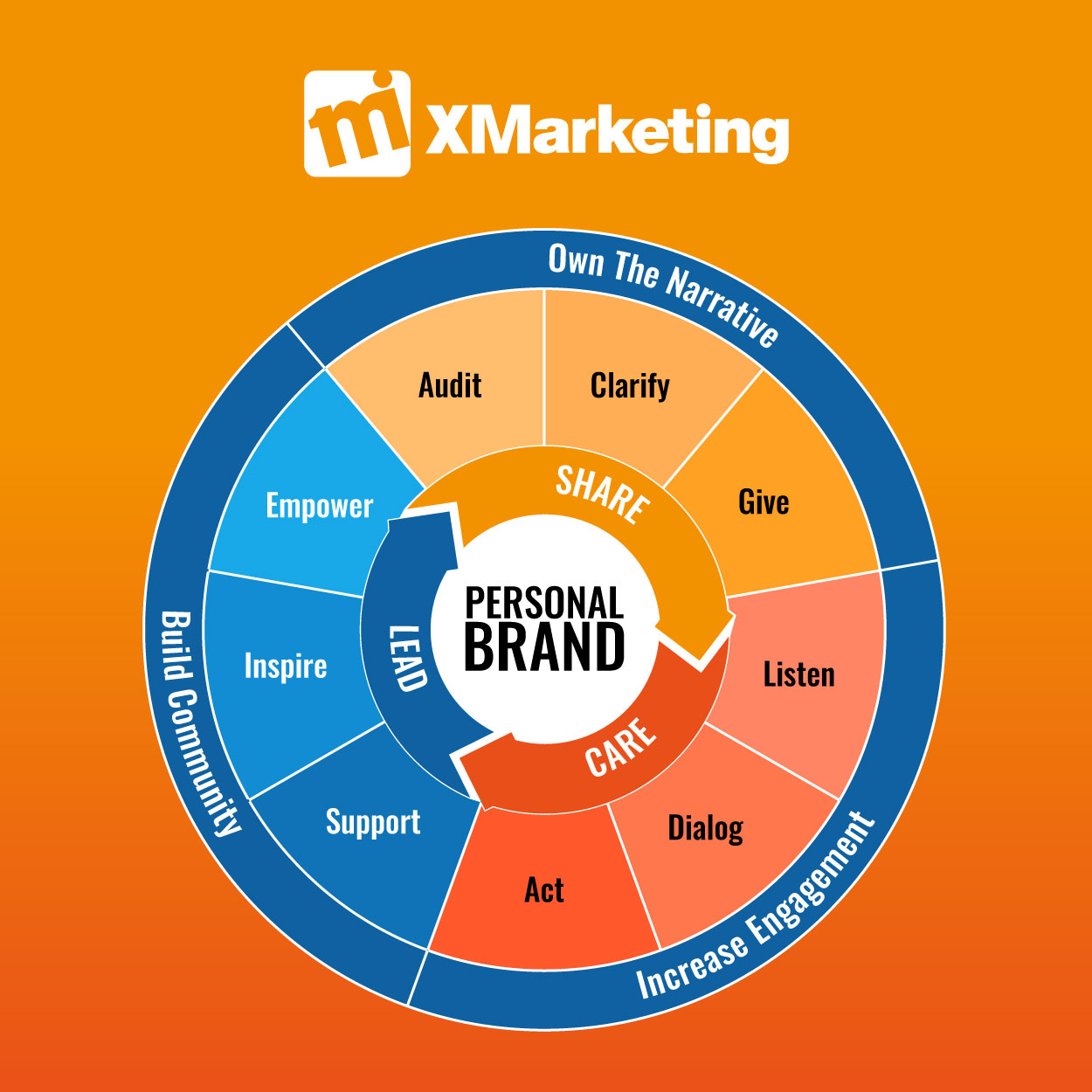
The XMarketing Framework: nine behaviors that turn a personal brand into an active reputation system.
1. Share: Own the Narrative
If you do not actively explain who you are, what you believe and how you create value, the market will assemble its own version from incomplete evidence. Sharing is how you make your expertise visible and give people accurate language to understand, remember and refer you. It is not constant self-promotion; it is useful, intentional communication.
Audit
Begin with reality. Audit what people currently encounter across Google, AI answers, your website, reviews, social profiles, videos, media mentions and competitor positioning. Compare the public evidence with the reputation you intend to build. The goal is to uncover gaps before producing more content.
Clarify
Decide what you want to be known for, whom you serve, which problem you solve, what makes your approach distinctive and which proof supports the promise. Clarity creates consistency across your biography, introductions, service pages, content and conversations. It makes the brand easier to explain—and easier to remember.
Give
Share expertise generously. Answer real questions, teach useful ideas, offer perspective and create resources that leave people more capable. Giving builds authority because the audience experiences value before being asked to buy. The strongest personal brands do not merely claim expertise; they demonstrate it repeatedly.
Your network also shapes the narrative people associate with you. As I discuss in this short Instagram video, “you are the average of the five people you surround yourself with” is more than a motivational phrase; your associations influence your thinking, standards and credibility. Watch the Instagram video: Your circle shapes your brand
Outcome: When you Audit, Clarify and Give, you earn the ability to own the narrative surrounding your name.
2. Care: Increase Engagement
A personal brand is not a broadcast channel. It is a relationship. Care turns attention into trust by showing people that they have been heard, understood and valued. It also closes the dangerous gap between what the brand promises publicly and what people experience privately.
Listen
Listen for more than compliments. Pay attention to reviews, objections, client questions, recurring frustrations, team feedback, search behavior and the language people use to describe their needs. Listening reveals whether your intended brand matches the reputation being formed in the real world.
Dialog
Create two-way conversation. Respond thoughtfully, ask better questions, invite perspectives and make your ideas accessible enough to discuss. Dialogue transforms an audience from passive observers into participants—and gives you the insight to make your message more relevant.
Act
Caring becomes credible through action. Improve the process, correct misinformation, follow through on promises, resolve friction and show how feedback changes the experience. Reputation is strengthened when people can see that listening leads to a meaningful response.
Outcome: When you Listen, Dialog and Act, you increase engagement because people experience the brand as responsive and human.
3. Lead: Build Community
Leadership is how a personal brand becomes larger than the individual. It means using visibility and authority to help others move forward. Communities grow around leaders who create belonging, raise standards and give people meaningful ways to participate—not around leaders who simply accumulate followers.
Support
Help people succeed through encouragement, introductions, resources, advocacy and follow-through. Support demonstrates that your relationships are not transactional and gives others a reason to remain connected to your work.
Inspire
Give people a compelling picture of what is possible. Stories, ideas, standards and personal example can move an audience from information to belief. Inspiration is strongest when it is grounded in truth and paired with a path people can act on.
Empower
Share opportunity, tools, credit and agency. Empowered people do not merely admire the brand; they carry its ideas into their own work, advocate for the community and help others participate. This is how a personal reputation creates reach beyond the moments you can personally control.
In this LinkedIn video, I explain that growing a personal brand is not a single campaign. It is a consistent practice of communicating value and nurturing the relationships around it. Watch the LinkedIn video: Growing your personal brand
Outcome: When you Support, Inspire and Empower, you build a community that reinforces and extends your reputation.
How the XMarketing System Works Together
Share, Care and Lead are not separate campaigns or a linear checklist. They form a continuous cycle. Sharing gives the market a clear and useful narrative. Caring makes that narrative believable through responsive experience. Leading turns trust into participation, advocacy and community. What you learn from the community then informs the next audit, clarification and act of giving.
Dimension | Three behaviors | Strategic outcome | Brand question |
Share | Audit • Clarify • Give | Own the Narrative | Are we intentionally shaping what people understand and remember? |
Care | Listen • Dialog • Act | Increase Engagement | Are people heard—and does their input change the experience? |
Lead | Support • Inspire • Empower | Build Community | Are we helping others participate, grow and carry the brand forward? |
How to Build a Personal Brand: A Practical 90-Day Plan
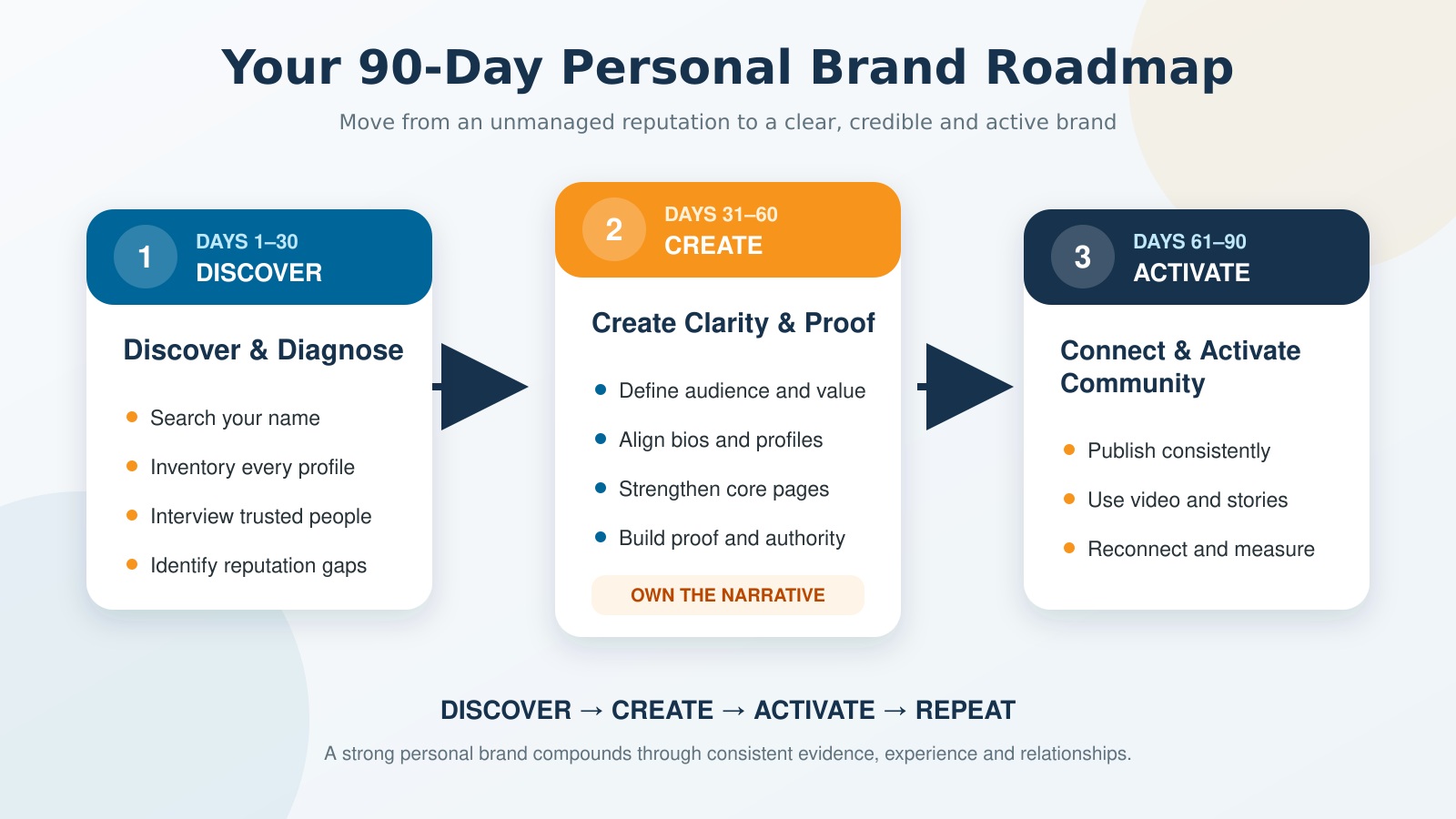
Days 1–30: Discover and diagnose
- Search your name in a private browser and document the first two pages of results, images, videos, review profiles and knowledge panels.
- Inventory every public bio, profile, service page, speaker page, byline and directory listing.
- Interview five to ten people who know your work. Ask what they rely on you for, how they describe you and which experience best represents your value.
- Compare your intended reputation with the evidence a stranger can find. Identify the three most consequential gaps.
A structured baseline prevents you from spending months creating content around the wrong problem. If you need an outside, evidence-based view, the Personal Brand Audit examines your public footprint across search, website experience, social media, video, reputation and competitive positioning—then turns findings into prioritized opportunities.
Days 31–60: Create clarity and proof
- Choose the audience, problem, promise, proof and point of view at the center of your brand.
- Rewrite the core website introduction, professional headline and biographies so they reinforce one another.
- Strengthen one cornerstone service page and one authoritative article that answers a high-value client question.
- Collect or improve testimonials, case examples, credentials and media proof. Confirm that every claim is accurate and permissioned.
Days 61–90: Connect and activate community
- Create a sustainable content rhythm around three to five themes—not a frantic daily publishing schedule.
- Record several short videos that communicate ideas, stories and answers in your natural voice.
- Reconnect with past clients and strategic relationships with useful, personal communication.
- Measure movement: branded search, qualified inquiries, referral sources, profile visibility, content engagement, speaking requests and sentiment in reviews.
What to Measure—and What Not to Worship
Personal-brand measurement should connect visibility to trust and business value. Vanity metrics can indicate distribution, but they do not prove authority. A million impressions from the wrong audience may be less valuable than five introductions from respected clients.
Leading indicators
- Growth in searches for your name, signature framework or branded offer.
- Improved completeness and consistency across priority profiles and search results.
- Qualified engagement: saves, substantive comments, replies, direct messages and invitations.
- Review volume, recency, themes and response quality—not only the average star rating.
- Backlinks, media mentions, podcast invitations and citations by credible third parties.
Business outcomes
- Qualified inquiries and the percentage that mention content, reputation or a referral.
- Referral rate and repeat-business rate.
- Speaking, partnership, recruiting and media opportunities.
- Sales-cycle length, close rate and reduced price resistance.
- Revenue connected to personal-brand-led opportunities.
Choose a small scorecard tied to your actual strategy. If your goal is speaking, track qualified inquiries and audience fit. If your goal is professional services, track referrals, qualified consultations and conversion. If your goal is category authority, track branded demand, citations and the quality of invitations.
Personal Branding Mistakes That Damage Reputation
Confusing constant visibility with strategic visibility
Publishing frequently is not a substitute for being meaningfully associated with something. Repetition helps only when the repeated idea is valuable, differentiated and relevant.

Inventing a persona
A manufactured identity is expensive to maintain and easy to expose. Strong branding selects and amplifies what is true; it does not fabricate character.
Making yourself the hero of every story
Your experience creates credibility, but the audience is usually trying to understand its own future. Use your story as a bridge to their problem, decision or aspiration.
Ignoring the experience after the click
A polished profile cannot rescue a confusing website, unanswered inquiry, late meeting or indifferent onboarding. Brand is what people experience, not what the brand guide promises.
Chasing platforms instead of building assets
Social platforms can distribute your ideas, but you do not control their algorithms or permanence. Build durable assets you own: a useful website, an email list, original frameworks, long-form articles, videos and genuine professional relationships.
Automating away your humanity
AI can accelerate research, drafting and repurposing. It should not erase your judgment, stories, standards or voice. Use technology to create more value and consistency—not more generic noise.
Treating reputation management as review suppression
Healthy reputation management listens, improves the underlying experience, encourages representative feedback and responds appropriately. It does not manipulate reviews or attempt to bury legitimate criticism with false praise.
When Personal Branding Becomes a Business Growth System
There is a point at which a personal brand stops being a communications project and becomes an organizational growth challenge. The founder may be creating demand that the company cannot consistently fulfill. Marketing, sales, operations and customer experience may tell different stories. The brand needs governance, measurement, prioritization and leadership.
That is where fractional executive leadership can help. My Fractional CMO consulting services connect brand strategy to the growth engine: positioning, priorities, teams, customer experience, measurement and execution management. The goal is not more random marketing. It is a coherent system that can scale beyond the founder.
Organizations also need a shared language for reputation, relationships and growth. A keynote can create that moment of alignment—giving leaders and teams a practical framework they can remember and use. Explore my personal branding and AI keynote programs built around XMarketing, authentic connection and the way technology is changing how reputations are discovered.
Frequently Asked Questions About Personal Branding (FAQs)
What is personal branding in simple terms?
Personal branding is the intentional shaping of what people understand, remember and expect when they encounter your name. It connects your real expertise and character to a clear public reputation.
Why is personal branding important for business owners?
It can accelerate trust, make referrals easier, differentiate the business, attract aligned opportunities and humanize the company. It is especially valuable when the owner’s judgment or expertise influences the buying decision.
Is personal branding the same as self-promotion?
No. Self-promotion calls attention to you. Personal branding creates a coherent expectation of value. Useful personal branding often emphasizes teaching, proof, service and relationships more than praise.
Can a personal brand exist without social media?
Yes. Reputation existed long before social platforms. A brand can be built through client experience, referrals, speaking, writing, media, community leadership, search visibility and professional relationships. Social media is one channel, not the brand itself.
How long does it take to build a strong personal brand?
Clarity can improve in weeks; a trusted reputation compounds over years. A focused 90-day effort can correct foundational gaps and establish momentum, but consistency and lived experience create durable authority.
How does personal branding affect SEO and AI visibility?
Clear authorship, consistent expertise, useful original content, accurate profiles, quality third-party mentions and accessible technical structure help search engines and AI systems understand who you are and when your work is relevant. No one can guarantee inclusion in an AI answer, but strong public evidence improves interpretability and trust.
Should doctors and attorneys build personal brands?
Yes, with professional and ethical safeguards. Both fields depend heavily on trust, clarity and reputation. Claims, testimonials, privacy, advertising rules and public responses should comply with the standards that govern the profession and jurisdiction.
What is the first step in personal branding?
Begin with discovery, not content production. Audit what people currently find, decide what you want to be known for, and identify the most important gap between the two.
The Personal Brand You Already Have
You already have a personal brand. It lives in the sentence someone uses to introduce you, the feeling a client remembers, the first page of search results, the story an employee repeats, the review a stranger trusts and the answer an AI system assembles from the public record.
The opportunity is not to manufacture a more impressive version of yourself. It is to make the most valuable, credible and human version of your work easier to understand, experience and share.
Start with reputation. Create clarity around what you want to be known for. Build connection through stories and experiences that prove it. Nurture a community that carries your value forward. That is how a name becomes a trusted brand—and how a trusted brand becomes opportunity.
Ready to see what your reputation is saying now? Start with the Personal Brand Audit.Explore the Personal Brand Audit →
About Daveeed Wagner
Daveeed Wagner is the founder of 1marketingidea, a personal branding keynote speaker and Fractional CMO. He helps influential professionals, thought leaders and businesses strengthen their reputations, clarify their value and build growth through the XMarketing Framework: Clarity, Connection and Community. His work combines more than two decades of marketing leadership with a practical belief that the strongest brands are built through authentic experiences and meaningful relationships.
Sources and Further Reading
- Google Search Central: Creating helpful, reliable, people-first content
- Google Search Central: Optimizing for generative AI features
- Edelman: 2025 Trust Barometer Special Report—Brand Trust
- BrightLocal: Local Consumer Review Survey 2026
- National Association of REALTORS®: 2025 Member Trends
- National Association of REALTORS®: What buyers and sellers want from agents
- American Medical Association: Building the right digital footprint
- American Bar Association: AI-powered search visibility for law firms